So your apartment complex forgot to raise your rent — and now you’re wondering if that’s your problem or theirs. Every month, the charge hits your account — and every month, it’s still the old, lower number. You haven’t said a word. And now you’re sitting there wondering: Should I keep my mouth shut, or is this about to blow up in my face?
Take a breath. You’re not alone, and you’re not automatically in trouble. But you need to understand exactly where you stand — legally, financially, and practically — before you make a single move.
Let’s break it all down.
What Happens When Your Apartment Complex Forgot to Raise Your Rent
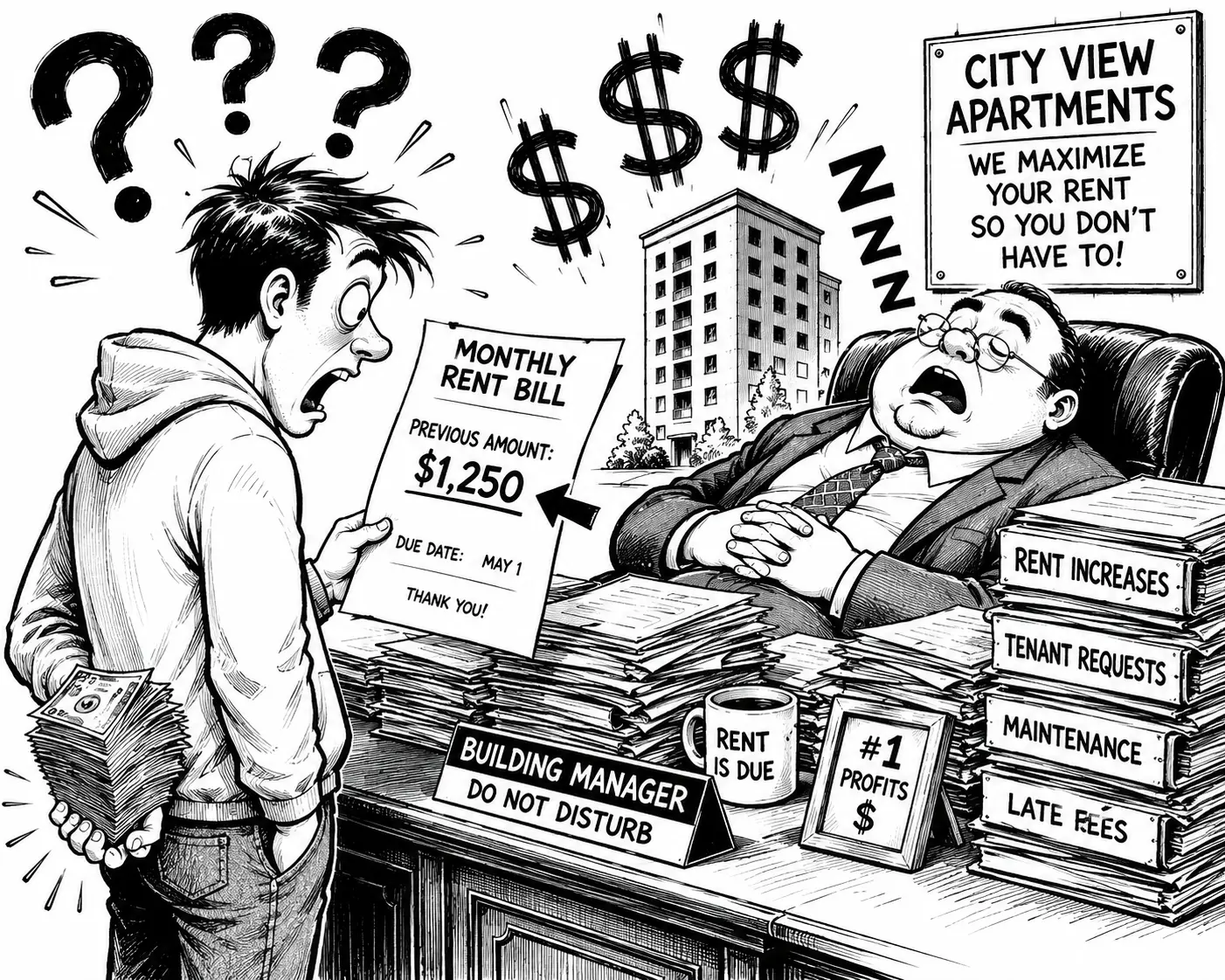
This happens more than most people realize. Property management companies get acquired. Staff turns over. Billing systems get migrated. And somewhere in all that chaos, your rent increase — the one you agreed to, signed off on, or at least verbally acknowledged — just… never makes it into the system.
The result? You keep paying the old amount. The system says “Paid in Full.” Life goes on.
Here’s the uncomfortable truth: you likely knew the amount being charged was lower than what was agreed. And that matters — not necessarily legally, but it shapes how you should think about the money sitting in your account right now.
A new property management company taking over means the communication gap is even wider. The old company had the paperwork. The new company has a spreadsheet and a prayer. These transitions are notoriously messy, and billing errors during ownership transfers are extremely common in the residential rental industry.
Should You Tell Your Landlord They Are Undercharging You?
Short answer: No. And here’s why that’s not morally complicated.
You have no legal obligation to proactively correct your landlord’s billing mistake. None. Zero. The burden of correct billing falls entirely on the landlord or property management company — not on you. If they invoice you for $1,400 and that invoice says “Amount Due: $1,400,” you paid what you were asked to pay.
Think about it this way: if your electric company accidentally undercharged you for three months, would you call them to volunteer extra money? Of course not. You’d pay what the bill says and keep it moving.
Now, some people feel genuine guilt about this. If that’s you, consider this perspective: large apartment management companies have entire accounting departments. They have auditors. They have software. It is not your job to do their bookkeeping for them.
What you should do — and this is non-negotiable — is save the difference every single month.
The Smart Money Move: High-Yield Savings Account for Back Rent
Here’s the play that financially savvy tenants make when this happens, and it’s the same thing financial professionals would tell you:
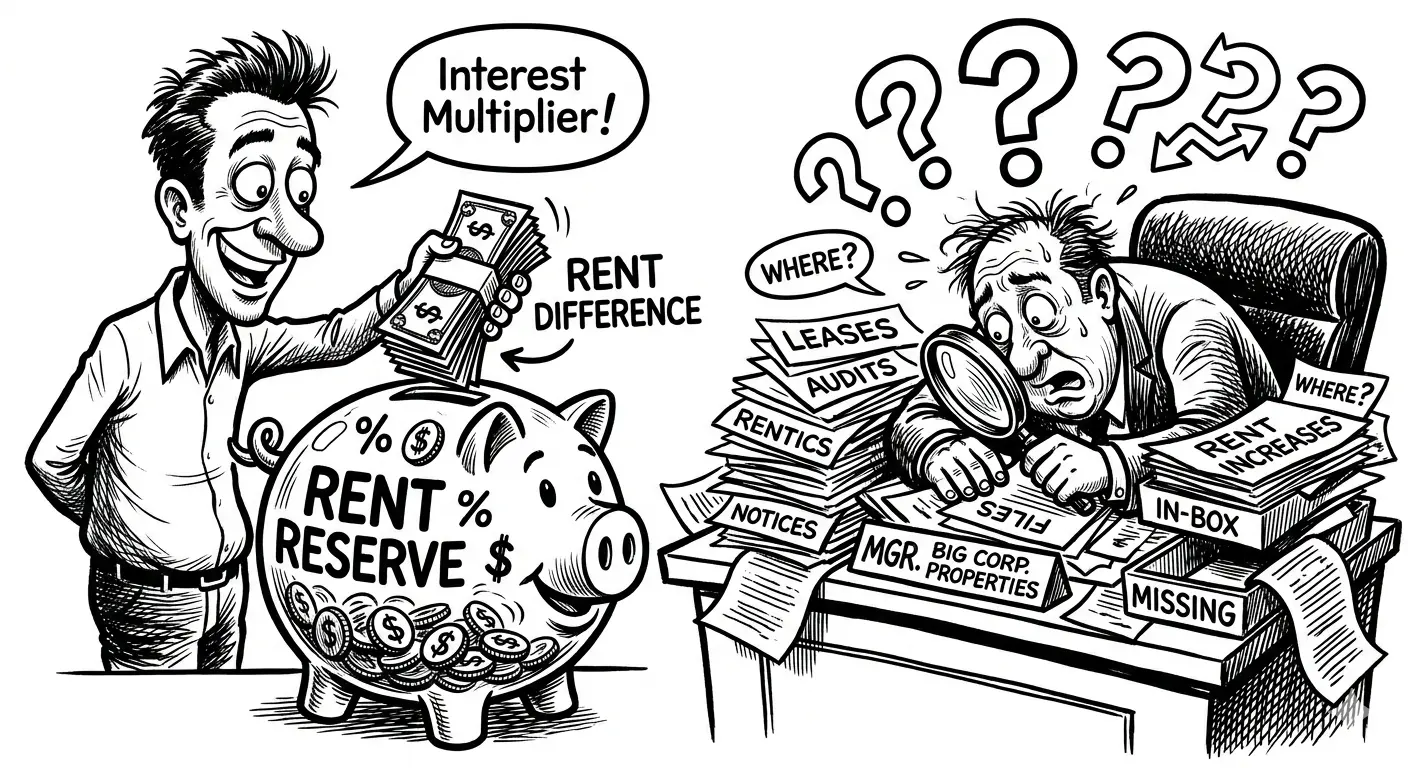
Open a high-yield savings account (HYSA) and park that difference there every single month.
When your apartment complex forgot to raise your rent, every month that passes is money you should be setting aside. If your rent increase was $100/month and it’s been 11 months, that’s $1,100 sitting there — plus interest. As of 2025, top HYSAs from institutions like Marcus by Goldman Sachs, Ally Bank, or SoFi are offering around 4–5% APY. That’s not life-changing money on $1,100, but it’s better than nothing, and more importantly, it keeps you protected.
Why does this matter? Because if the landlord discovers the discrepancy six months from now and demands the full back rent in a lump sum, you’ll have it. Ready. No panic. No payment plan negotiations. You just write the check (or initiate the transfer) and move on.
The worst position you can be in is spending the money you should have been paying and then having nothing when they come calling.
Pro tip: Label the savings bucket something like “Rent Reserve” so you’re never tempted to dip into it for a weekend trip or a new couch.
Can a New Property Management Company Claim Back Rent?
This is where it gets legally interesting — and the answer depends on your specific situation.
If you signed a new lease or addendum reflecting the increased rent amount, then yes, the management company — new or old — likely has legal grounds to collect the unpaid difference. Your signature is your agreement. The fact that they failed to charge you correctly doesn’t erase the debt created by a signed contract.
If the rent increase was verbal only, or if you never signed any updated paperwork, the situation is significantly more complicated for the landlord. In most U.S. states, enforceable lease changes require written documentation. If there’s no signed amendment, no updated lease, and no written notice that you acknowledged, you have a much stronger argument that the old rate was your actual rent.
If you’re on a month-to-month arrangement, the landlord typically needs to give proper written notice (usually 30 days, though this varies by state) to implement any rent change. If that notice was never given — or wasn’t given by the new management company — the increase may not be legally binding at all.
According to the National Housing Law Project, tenants’ liability in billing error situations often hinges on whether there was a clear, written, executed agreement establishing the new rent amount — and whether proper notice procedures were followed.
Bottom line: dig out every piece of paper you have. Your original lease, any addendums, any emails or text messages about the increase. Know what you signed before you do anything else.
Am I Liable for Back Rent If I Signed the Lease But Wasn’t Billed Correctly?
Potentially, yes. This is the part nobody wants to hear, but you need to know it.
If you signed a lease or addendum clearly stating your new rent is $X, and you’ve been paying less than $X for a year, you technically have an underpayment on your account. The management company could come back and ask for the full difference.
However, here’s what typically happens in the real world:
Scenario A: They notice, contact you, ask for the back rent. You pay it (because you saved it). Problem solved. Most landlords who discover this kind of error don’t want to lose a good tenant over their own accounting mistake. They want the money and they want to move on.
Scenario B: They notice it at move-out. They deduct some or all of it from your security deposit. This is a common outcome in apartment management transitions.
Scenario C: They never notice. The ownership change created such chaos in the records that the old data simply doesn’t get reconciled. You move out, get your deposit back (assuming you left the place in good shape), and that’s the end of it. This happens more often than you might think.
Scenario D (rare but possible): They claim late fees on top of the back rent. This is where you want to push back hard. You paid exactly what you were invoiced. You cannot be held responsible for late fees when the invoice itself showed the wrong amount. Keep every single receipt, every payment confirmation, every bank statement. Document everything.
Can You Get Evicted for a Landlord’s Billing Mistake?
This is the fear that keeps people up at night. So let’s just say it plainly: in most cases, no.
Eviction proceedings in the U.S. are typically triggered by a tenant’s willful failure to pay rent after receiving proper notice. If you have been paying what your invoice says, in full, every month, on time — you have not failed to pay rent. You paid what was demanded.
Now, if a landlord sends you a formal notice of the actual rent owed and a demand for the difference, and you then refuse to pay — that’s a different situation. At that point, you’re in dispute territory and you may want to consult a tenant’s rights attorney.
But the scenario where a management company evicts a long-standing, otherwise good tenant over their own billing error? Courts generally do not look kindly on that. And any competent property manager knows it would cost them far more to turn over the unit than to work out a payment arrangement.
What If They Put You on Autopay — Can They Just Take What They Want?
This is a really important point that doesn’t get enough attention.
If your rent is set up on autopay — especially through the landlord’s own portal like RentCafe, Yardi, AppFolio, or similar — the system is only going to pull what’s entered as the amount due. If their system says $1,400 and you authorized $1,400, that’s all they can pull without your express consent to a change.
What you should NOT do: authorize any blanket autopay increase without a written notice in hand explaining exactly what you’re agreeing to and why.
If they want to collect back rent, they need to notify you in writing, give you a reasonable window to respond, and come to an agreement on repayment. They don’t get to just reach into your account and take it.
Review your autopay authorization carefully. Make sure it specifies an amount or requires your explicit approval for changes.
Does a Landlord Error Waive the Rental Agreement Terms?
Legally, a landlord’s billing error does not automatically void the lease. The signed lease remains the operative document. However, the concept of “waiver” does come into play in some jurisdictions.
If a landlord consistently accepts a lower rent amount for a prolonged period without objection, some courts have found this creates an implied acceptance of the lower amount — particularly in month-to-month situations. This is not a universal rule and varies significantly by state, but it’s a real legal concept worth knowing.
If you’ve been underpaying for close to a year and the landlord’s billing system has shown “Paid in Full” every month without any notice of discrepancy, that pattern of accepted payment matters. It’s not a guaranteed defense, but it’s meaningful context.
This is another reason to keep every single payment confirmation and every statement that shows your account as current.
The “Play Dumb” Strategy — And When It’s Actually Smart
Some people’s instinct is to feign complete ignorance if the landlord brings up the discrepancy. “Oh, I just paid what was on the bill — I had no idea there was a difference.”
Honestly? That’s a completely reasonable position. You did pay what was on the bill. If the bill said the wrong amount, that’s the property management company’s error, not yours. You’re not obligated to be an expert in their accounting systems.
Where this gets complicated is if you have written documentation — like a signed lease addendum clearly stating the new rent amount — that makes it obvious you knew. At that point, playing dumb isn’t credible and it’s not worth trying.
But if the increase was informal, verbal, or communicated in a way that’s now lost in the transition between companies? You have more room to work with.
How Long Does a Landlord Actually Have to Come After You? A State-by-State Breakdown
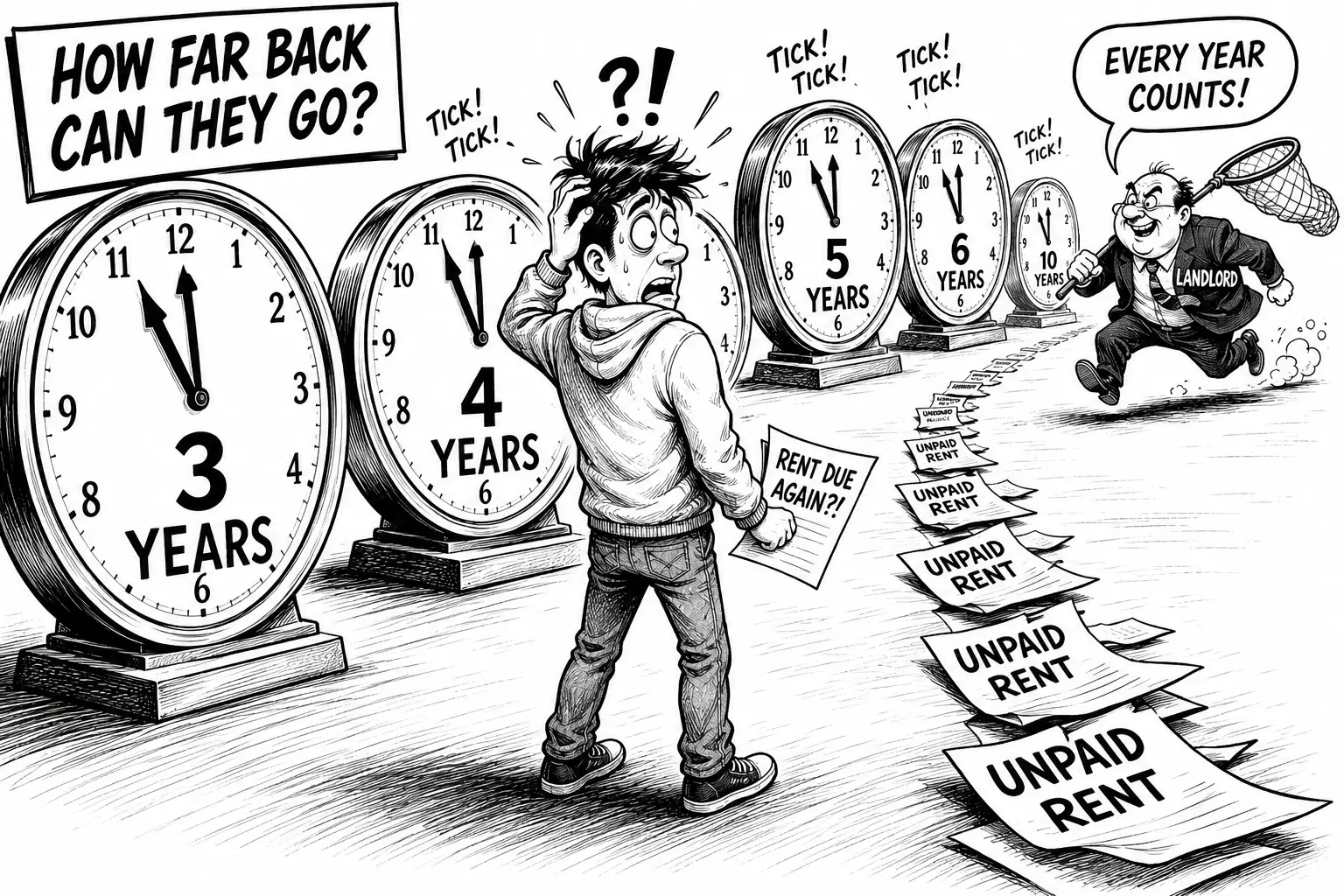
Here’s the part that most renters never look up — and probably should. Every state has a statute of limitations (SOL) for written contract claims. In plain English: that’s the legal clock. Once it runs out, your landlord cannot sue you for that back rent. Period. Courts will throw the case out.
This is why the “save the money” strategy has a natural expiration date. In some states, that clock is surprisingly short. In others — Illinois, we’re looking at you — it’s a full decade.
Here’s what you actually need to know for the six states where this comes up most often:
California — 4 Years
Under California Code of Civil Procedure § 337, a landlord has four years from the date of the alleged underpayment to sue you for breach of a written lease. For oral-only agreements, that window shrinks to two years. The clock starts ticking from when the rent was supposedly owed — not from when they discover the error. California renters can also reference the California Department of Consumer Affairs Tenant Guide for broader rights and protections.
One important nuance for California: even within that four-year window, a 3-day pay-or-quit notice for unlawful detainer (eviction) can only include rent going back up to 12 months under California Civil Code § 1161. So the clock ticks differently depending on whether they’re trying to evict you versus just sue you for money. Most landlords discovering a billing error will be after money — not your apartment — which keeps the four-year SOL relevant.
New York — 6 Years (with Important Caveats)
New York gives landlords a long runway. Under CPLR § 213(2), breach of a written contract carries a strict six-year statute of limitations. While New York’s Consumer Credit Fairness Act shortened the timeline for credit cards and medical debts to three years, state courts (including Lefferts Ave. Ventures LLC v. Keennlyside) have repeatedly ruled that back rent is not a consumer credit transaction. A landlord who discovers a billing error today can legally come after up to six years of accumulated unpaid rent. For rent-stabilized apartments specifically, additional administrative and formatting rules governed by New York State Homes and Community Renewal (HCR) apply on top of standard contract limits.
Note: Remember to update the “6 years (3 for some debt collection)” in your Quick-Reference Table to a clean “6 years”.
Texas — 4 Years
Texas keeps it relatively straightforward. Under Texas Civil Practice & Remedies Code § 16.004, actions for debt and breach of contract carry a four-year limitation period. Notably, Texas does not differentiate between oral and written contracts for this particular limitation — both get four years.
Texas renters dealing with any landlord dispute can reference the Texas Attorney General’s Tenant Rights Portal for guidance on notice requirements, dispute resolution, and your rights when ownership changes.
Florida — 5 Years
Florida leans landlord-friendly in many ways, but the statute of limitations here gives tenants a reasonable window. Under Florida Statutes § 95.11(2)(b), written lease disputes can be pursued up to five years from the date of the alleged breach. Oral agreements fall under a shorter four-year limit.
The key phrase here is “from the date of the breach.” For a billing error where you’ve been charged the wrong amount every month, each underpayment could technically be its own separate breach starting its own clock — or courts might look at it as a continuing single breach. This gets complicated fast. Florida renters can find general tenant protection information through the Florida Department of Agriculture and Consumer Services (FDACS), which oversees landlord-tenant disputes in the state.
Illinois — 10 Years (Yes, Really)
Illinois has one of the longest statutes of limitations for written contracts in the entire country. Under 735 ILCS 5/13-206, a written contract carries a ten-year statute of limitations. That means if you signed paperwork agreeing to a higher rent, an Illinois landlord technically has a decade to come after the difference.
If you’re in Chicago specifically, things get even more layered. The Chicago Residential Landlord and Tenant Ordinance (RLTO) provides additional tenant protections — including strict rules around notice, security deposits, and lease disclosures — that run alongside state law. Chicago tenants have some of the strongest protections in the country, and the RLTO is the document you want to know.
Maryland — 3 Years (And Landlords Cannot Contractually Extend It)
Maryland has the shortest SOL on this list, and also the most aggressively tenant-protective law around it. The three-year limitation for back rent on residential leases has been firmly established through a series of landmark court decisions — most recently affirmed in Simmons v. Maryland Management Co., 253 Md. App. 655 (2022).
Here’s the remarkable part: Maryland courts have ruled that landlords cannot contractually extend this three-year window. Some management companies had actually been including lease clauses that claimed a twelve-year limitations period for their own benefit. Maryland courts threw that out entirely. Under Maryland Real Property Article § 8-208(d)(2) (the anti-waiver provision), any lease clause that tries to waive a tenant’s rights — including statutory time protections — is unenforceable. If you’re in Maryland, three years is the ceiling, full stop, and your landlord cannot change that in the fine print.
Maryland renters can find additional resources through the Maryland Office of the Attorney General’s Consumer Protection Division.
A Quick-Reference Table
| State | SOL for Written Lease | Key Statute | Official Resource |
|---|---|---|---|
| California | 4 years | CCP § 337 | CA Dept. of Consumer Affairs |
| New York | 6 years (3 for some debt collection) | CPLR § 213(2) | NY AG Tenant Guide |
| Texas | 4 years | CPRC § 16.004 | TX AG Tenant Rights |
| Florida | 5 years | Fla. Stat. § 95.11(2)(b) | FDACS Landlord-Tenant |
| Illinois | 10 years | 735 ILCS 5/13-206 | Chicago RLTO |
| Maryland | 3 years (non-waivable) | CJP § 5-101 | MD AG Consumer Protection |
Don’t see your state? Most states fall somewhere in the 4-6 year range for written contracts. The National Housing Law Project maintains resources that can help you identify the applicable law in your jurisdiction.
Why This Table Changes Everything
Here’s the insight that table unlocks: where you live determines your risk timeline more than almost anything else.
If you’re in Maryland and the underpayment has been going on for more than three years — and you’ve moved out — you may already be beyond the landlord’s legal reach. If you’re in Illinois and still living there, that ten-year clock means you’re not out of the woods for a very long time. Save accordingly.
If you’re currently still in the apartment, the clock doesn’t run while the tenancy is ongoing for practical purposes — the landlord can bring the claim at any time before or after you move out, as long as it’s within the SOL window from the date the breach occurred.
A Practical Checklist: What to Do Right Now
Here’s exactly what you should do today, this week, and going forward:
Today:
- Pull out your lease, any addendums, and any written communications about the rent increase
- Note whether you ever signed anything reflecting the new amount
- Check your payment history — make sure every month shows as paid and current in your tenant portal
This week:
- Open a dedicated high-yield savings account if you haven’t already
- Transfer the back-difference you haven’t been paying into it (all of it, not just going forward)
- Set up an automatic transfer each month for the increase amount going forward
Ongoing:
- Screenshot your tenant portal “Account Balance” every month showing your account as current
- Save every emailed receipt or payment confirmation
- Do not volunteer any information about the discrepancy to management
If they contact you:
- Respond calmly and professionally
- Ask for everything in writing
- Do not agree to any payment arrangement without reviewing it carefully
- Remember: you have the money saved, so you’re not in a desperate position
The Bottom Line on Your Apartment Complex Forgetting to Raise Your Rent
Here’s the real talk version of everything above:
You didn’t steal anything. You paid what you were asked. The responsibility for correct billing lies with the property management company, not with you. That said, if you signed documentation agreeing to the higher rent, that agreement doesn’t disappear just because someone failed to type the right number into a system.
The safest, smartest, most financially responsible thing you can do is exactly what experienced tenants do: pay what’s billed, save the difference, and stay prepared.
There’s a very real chance they never figure it out. And there’s also a real chance they do. Either way, if you’ve been stashing that $100 (or whatever your number is) every month in a HYSA, you come out ahead no matter what happens. You either get to keep it, or you pay it back with a few extra bucks in interest earned.
That’s not gaming the system. That’s just being smart about your money while life sorts itself out.
Official Resources by State
If you’re dealing with a rent billing dispute and want to dig deeper into the law in your state, here are the primary official and authoritative resources referenced throughout this article:
California
- California Code of Civil Procedure § 337 — Written Contract Limitations — The four-year clock for written lease disputes
- California Department of Consumer Affairs — Landlord-Tenant Guide — Comprehensive tenant rights overview
New York
- New York CPLR § 213 — Six-Year Contract Limitations — The standard written contract SOL
- New York State Homes and Community Renewal (HCR) — Governing body for rent-stabilized and rent-controlled units
- NY Attorney General Residential Tenants’ Rights Guide — Complete overview of tenant protections statewide
Texas
- Texas Civil Practice & Remedies Code § 16.004 — Four-Year Limitations — Debt and contract claim limits
- Texas Attorney General — Tenant Rights Portal — Notice requirements, rights on ownership transfers
Florida
- Florida Statutes § 95.11 — Statute of Limitations — Five-year window for written lease claims
- Florida Department of Agriculture and Consumer Services (FDACS) — Landlord-Tenant Law — Primary state consumer protection resource for renters
Illinois
- 735 ILCS 5/13-206 — Ten-Year Written Contract Limitations — Illinois’s exceptionally long SOL
- Chicago Residential Landlord and Tenant Ordinance (RLTO) — Additional strong protections for Chicago renters
Maryland
- Simmons v. Maryland Management Co., 253 Md. App. 655 (2022) — The landmark case cementing the three-year non-waivable cap
- Maryland Office of the Attorney General — Consumer Protection Division — Tenant rights, complaints, and landlord regulations
National
- National Housing Law Project — National advocacy and legal resource for tenants across all states
This article is for informational purposes only and does not constitute legal advice. Landlord-tenant laws vary significantly by state and may have changed since publication. If you’re facing a formal demand for back rent or any kind of legal notice, consult a licensed attorney in your jurisdiction.