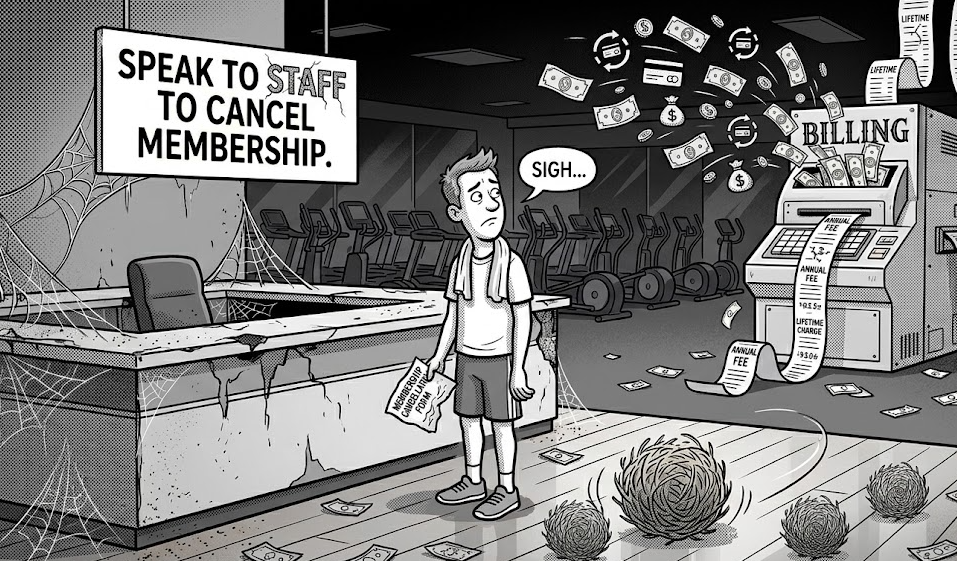
I spent three months trying to cancel a gym membership at a facility that had quietly eliminated all of its front-desk staff. Every time I called, the line rang out. Every time I visited, the lobby was empty. Yet my bank account was hit like clockwork — monthly dues plus a “maintenance fee” — with no one to call, no one to email, and a website that directed me to “speak with a team member” who simply did not exist.
If you are in the same situation right now, here is exactly what I did to get out — in the order that worked.
Send a Certified Cancellation Letter (This Is the Fastest Legal Lever You Have)
Before you try anything else, do this first: draft a formal cancellation letter and send it via USPS Certified Mail with Return Receipt Requested to the gym’s corporate headquarters address and, if you have it, to their third-party billing company.
I know it sounds old-fashioned. It works because of one reason: that green return-receipt card, once signed and returned to you, becomes a legally verifiable record that the company received your cancellation request. A phone call can be denied. An email can be “lost.” A signed certified mail receipt cannot be dismissed by a collections agency or a credit bureau.
In your letter, include the following:
- Your full name, membership number, and the address on file
- A clear statement that you are terminating the contract effective immediately
- The specific reason: the facility is operating without on-site staff, making their required in-person cancellation process impossible to complete
- A citation of the relevant state consumer protection law (see below)
- A request for written confirmation of cancellation and a refund of any charges billed after the date of your letter
Which law do you cite? This depends on your state. Here are two real statutes that directly apply to this situation:
- Oregon: ORS 646A.295 requires businesses offering automatic renewal contracts to provide a “timely, cost-effective, and easy-to-use” mechanism for cancellation. An unstaffed facility with no phone support fails this standard.
- Illinois: The Illinois Automatic Contract Renewal Act (815 ILCS 601/) requires clear cancellation procedures and imposes liability on businesses that make cancellation unreasonably difficult.
If you are in another state, search your state attorney general’s website for “automatic renewal law” — most states have enacted similar protections over the past decade. The Federal Trade Commission’s updated Negative Option Rule, which took effect in May 2024, also now requires businesses to make cancellation “as easy as enrollment” at the federal level, regardless of which state you live in.
Check Your Gym’s Online Portal and Change Your Billing State (Where Applicable)
After sending your letter — not instead of it — log into your gym’s online member portal and look for a cancellation option. Some national chains like Planet Fitness allow online cancellations through their member portal, though the availability of this option has varied by location and membership type.
If no cancellation button is visible, some members have reported that updating their profile address to a state with stricter automatic renewal laws — California being the most commonly cited example — causes a self-service cancellation option to appear. California’s Automatic Renewal Law (Business and Professions Code §17600–17606) requires that any business that allows online sign-up must also provide online cancellation through the same channel.
Important caveat: This is a workaround that other consumers have reported, and its effectiveness will depend entirely on how your gym’s software is built. I would treat it as a secondary option to try, not a reliable primary method. Your certified letter is your strongest move.
Dispute Any Collections Activity Through the FCRA
If the gym or their billing company sends your balance to a collections agency and that agency attempts to report it to the credit bureaus, you have a clear path to fight it.
Under the Fair Credit Reporting Act (FCRA), you have the right to dispute any inaccurate or unfair item on your credit report. Here is what I did, and what I recommend:
- Keep a copy of your certified mail receipt and the green return-receipt card after cancellation.
- If a collections entry appears on your report, file a dispute with Equifax, Experian, and TransUnion simultaneously. Each bureau has an online dispute portal, or you can write to them at their official dispute addresses.
- In your dispute, attach a copy of the certified mail documentation and state that the original debt is invalid because the creditor made cancellation procedurally impossible and violated applicable automatic renewal statutes.
- Send a copy of the same documentation to the collections agency directly, and notify them in writing that you will pursue a small claims court action if they continue to report the debt.
Collections agencies, particularly those handling gym debt, frequently drop disputed accounts rather than defend them when the consumer has a documented paper trail. This is not guaranteed, but it is a well-established pattern.
What About the ADA Angle?
One additional avenue worth knowing about: when a company goes fully unstaffed and removes all accessible communication channels — no phone, no email, no in-person staff — it may create accessibility barriers for people who require assistance navigating contract terms due to a disability.
If you or someone you are helping has a disability and genuinely cannot complete the cancellation process through the channels the gym has left available, the National Disability Rights Network (NDRN) operates a Protection and Advocacy system in every state. State-level organizations like Disability Rights Oregon have the authority to investigate businesses that use automated systems in ways that exclude people with disabilities. Filing a complaint here is a legitimate option when other channels have failed, particularly if the company is part of a larger private equity-backed chain with resources to comply but a clear pattern of not doing so.
If you are in the northeast, companies cannot slide past New York General Business Law § 527-a, which bans continuous service providers from intentionally hiding or obscuring functional opt-out links.
What I Would Not Recommend
A few things I have seen suggested elsewhere that I would caution against:
Blocking the charge at your bank without sending cancellation notice first. Banks can reverse these charges through a dispute process, but if you have not created a cancellation paper trail first, the gym can legitimately re-report the charge and the bank may side with them on a second review. Get your certified letter out before you take any action with your bank.
Just stopping payment and hoping nothing happens. Gym debt, even small amounts, is routinely sold to third-party collectors. A $30-per-month membership left unpaid for six months can become a $500 collections account on your credit report after fees. The certified letter costs you roughly $8 at the post office. It is worth it.
Quick Reference: The Three-Step Process
Step 1 — Send Certified Mail: Draft a formal cancellation letter, cite your state’s automatic renewal law or the FTC’s Negative Option Rule, and mail it certified with return receipt to the gym’s corporate office.
Step 2 — Try the Online Portal: Log into your member account and attempt to cancel through the portal. If unavailable, explore whether a billing address update to a stricter-regulation state unlocks an online cancellation option.
Step 3 — Protect Your Credit: If collections activity appears, file FCRA disputes with all three bureaus using your certified mail receipt as documentation, and notify the collections agency in writing of your intent to pursue small claims court if needed.
The information in this article reflects my personal experience and publicly available consumer protection statutes as of the date of publication. Laws vary by state and change over time. Before taking steps that could affect your credit or contractual obligations, consider verifying your state’s current statutes through your state attorney general’s office or consulting a licensed consumer protection attorney.