Savings rates that were sitting above 4% two years ago are now hovering around 3% at most major online banks. SoFi, Marcus, American Express, Capital One, Apple Savings — all of them have come down. If you’ve been watching your APY shrink and wondering whether you’re getting a bad deal, that reaction makes sense. It also probably isn’t leading you toward the right question.
Watching your savings rate fall can feel like your bank is taking something away from you. That’s understandable. But before opening another account, it’s worth finding out whether the difference is actually large enough to change your financial outcome.
The right question isn’t “which bank is paying more?” It’s “how much am I actually losing, and is it worth doing anything about it?”
For most savers, the math is going to surprise you.

Do the Math Before You Do Anything Else
This is the calculation almost nobody runs before they start looking for a new bank.
Take your balance. Multiply by the APY difference. That’s your annual gain from switching.
A $20,000 balance at 3.10% earns $620 in interest per year. At 4.10% — a full percentage point higher — it earns $820. The difference is $200 for the year, or about $16.67 per month.
The balance threshold matters here. At around $50,000 in savings, a 1% APY difference translates to roughly $500 per year. For many people, that’s enough to justify comparing alternatives more carefully. At $20,000, the same gap produces $200. At $10,000, it’s $100. The further below $50,000 your balance sits, the less the rate gap is worth acting on.
That doesn’t mean APY doesn’t matter. It means the decision deserves about as much effort as its dollar value suggests — which, for most people with modest balances, is not very much.
Why Rates Fell Everywhere at Once
SoFi didn’t lower your rate because it decided to. Every bank you’re considering moving to has done the same thing for the same reason.
The Federal Reserve cut its benchmark interest rate multiple times in 2024, according to Federal Reserve meeting records. Banks price their savings accounts off that benchmark — when the Fed rate goes down, savings APYs follow. The high-yield savings rates of 4.5% and 5% that appeared in 2022 and 2023 weren’t the new normal. They reflected an aggressive rate-hiking cycle that has since reversed.
The banks you’re researching as alternatives are operating under the same conditions. The rates that look appealing today will move in the same direction as your current bank when the Fed moves next.
The Promotional APY Problem
When you search for the “best HYSA rates,” a meaningful portion of what you’ll find is promotional pricing. A bank advertises 4.50% to attract new deposits, then drops to 3.20% after a set period — sometimes six months, sometimes tied to conditions like a direct deposit requirement or a minimum balance.
Before opening any new savings account, answer these questions:
Is this APY promotional, and if so, when does it expire? Does the rate require a direct deposit, and at what minimum amount? Is there a minimum account balance to earn the advertised rate? Are there monthly fees that reduce what you actually net?
A promotional 4.50% that becomes 3.10% in six months gives you almost exactly what you already have — plus the friction of opening an account, verifying identity, moving funds, and updating any automatic transfers. That’s a lot of work for a temporary gain.
When It Actually Makes Sense to Move
There are situations where switching is the right call.
If your balance has crossed roughly $50,000, a persistent 1% rate difference becomes meaningful enough — around $500 per year — that it’s worth taking seriously. The key word is persistent: look for a bank where the rate reflects their standard offer, not a promotional window.
If you have specific banking friction with your current provider — poor app experience, slow transfers, unreliable customer service — a switch might be worth it for operational reasons regardless of rate. Convenience has real value, and so does its absence.
If you’re opening a new account from scratch, there’s no switching cost at all. In that case, comparing rates makes complete sense.
Outside of these situations, the time spent researching, opening, and managing a new account is almost certainly worth more than the interest difference.
What Often Pays More Than a HYSA
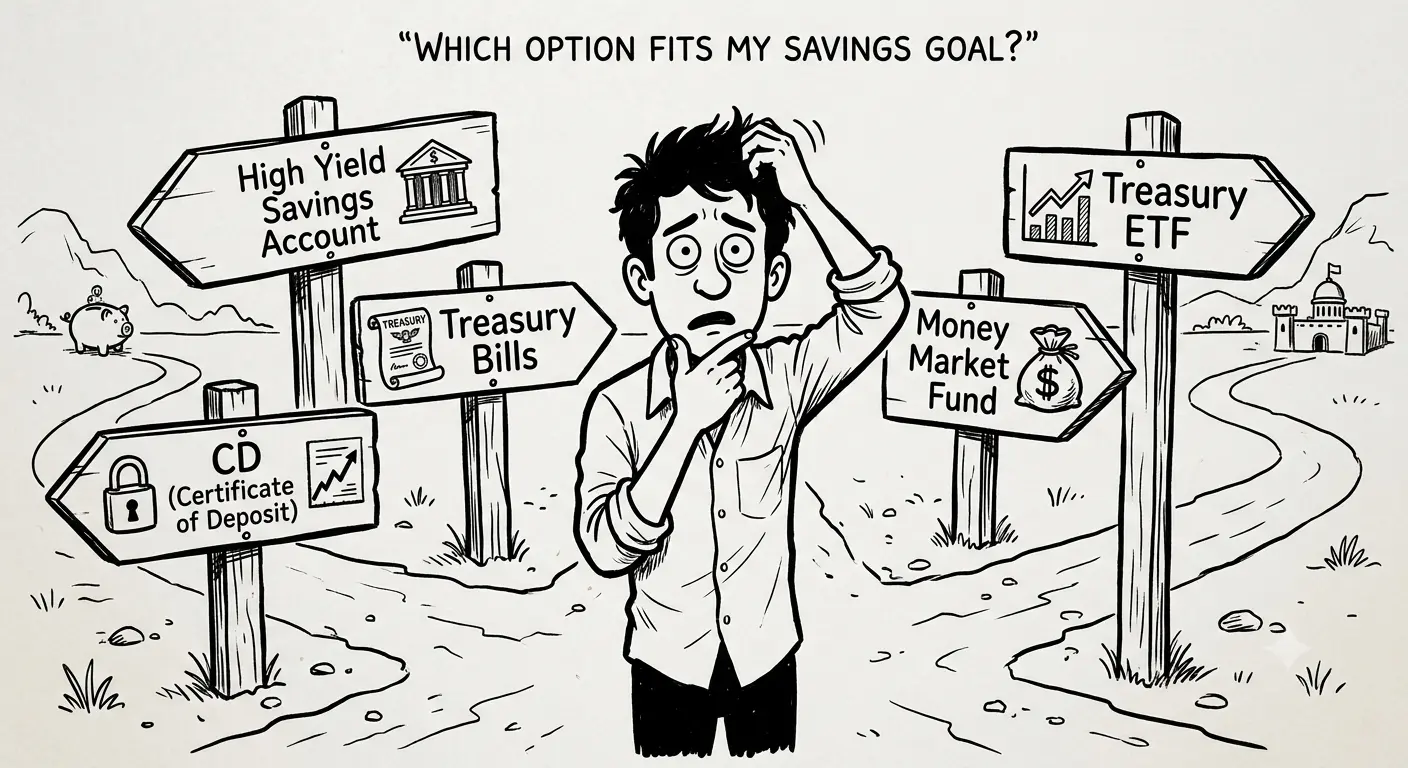
For savers who have their emergency fund covered and want to earn more on cash they won’t need immediately, several alternatives have tended to offer higher yields than high-yield savings accounts in certain rate environments — with one meaningful tradeoff.
| Option | Best For | Typical Access Time | State Tax Benefit |
|---|---|---|---|
| HYSA | Emergency fund | Immediate | No |
| Treasury Bills | Cash you won’t need until maturity | At maturity, or by selling early through a brokerage | Yes |
| Treasury ETF (e.g., SGOV, VBIL) | Brokerage cash reserves | Usually 1–2 business days after sale | Mostly yes |
| Treasury Money Market Fund (e.g., VUSXX, FDLXX) | Cash held in a brokerage account | Usually same or next business day within the brokerage | Depends on fund |
| CD | Money you can lock away for a fixed term | At maturity (early withdrawal penalties may apply) | No |
Treasury Bills
Treasury bills are short-term debt instruments issued by the U.S. government. You lend the government money for a set period — 4, 13, or 26 weeks — and receive the principal plus interest when it matures. Because they’re backed by the full faith and credit of the federal government, they carry essentially no credit risk. The U.S. Treasury publishes current rates at TreasuryDirect.gov, and the FDIC has no role here — Treasury securities are a government obligation, which is a different and widely accepted form of security.
As of mid-2025, the 13-week Treasury bill yield has been running in the 3.80–4.00% range, somewhat above what most HYSAs are paying. You can purchase them directly at TreasuryDirect.gov or through a brokerage account at Fidelity, Schwab, or Merrill Edge.
The state tax advantage makes Treasury bills especially useful in high-tax states. Interest earned on T-bills is exempt from state and local income taxes. If you live in California, New York, Illinois, or another high-tax state, the after-tax yield on a T-bill at 3.80% may exceed what a HYSA at 4.20% nets you once state taxes are factored in.
The tradeoff is liquidity. If you buy Treasury bills directly through TreasuryDirect.gov, early redemption before maturity isn’t straightforward. If you buy through a brokerage like Fidelity or Schwab, you can generally sell before maturity on the secondary market, though the sale price will depend on current market conditions — you may get slightly more or less than the face value. For emergency funds, this matters. For savings you don’t need to touch, it doesn’t.
Treasury ETFs
Treasury ETFs like SGOV and VBIL are exchange-traded funds that hold very short-term U.S. Treasury securities — typically bills maturing within a few months. They trade on the stock market during market hours, carry essentially the same government-backed credit quality as T-bills held directly, and pass through the same state tax exemption on most of their income.
These funds are popular among investors who want a place to park cash while maintaining relatively easy access through a brokerage account. You buy and sell them like any stock — no need to navigate TreasuryDirect or understand bill auctions. Settlement after a sale takes one business day, with an external bank transfer requiring another one to three days.
It’s worth noting that the yields on Treasury ETFs, like all Treasury-related instruments, fluctuate with market interest rates. In recent periods, SGOV and VBIL have been yielding in the 3.50–3.60% range, but that will shift as rates change.
Treasury Money Market Funds
Options like VUSXX (Vanguard Treasury Money Market), FDLXX (Fidelity Treasury Only), and VMFXX (Vanguard Federal Money Market) hold short-term Treasury and government securities. They’re designed to maintain a stable $1.00 net asset value, meaning they don’t fluctuate in price the way stock or bond funds do. Yields have been in the 3.50–3.65% range as of mid-2025, though these also move with market conditions.
The practical difference from Treasury ETFs: money market funds don’t require selling shares and waiting for settlement. They function much like a savings account within a brokerage — you can move money in and out relatively quickly. Transfers to an external bank account still take a day or two, but there’s no separate “sell, wait, then transfer” sequence.
Fidelity’s education center and Vanguard’s investor resources both offer detailed explanations of how these funds work for savers evaluating them for the first time.
Where a HYSA Still Makes Sense
None of the alternatives above are right for every situation.
If your savings are your emergency fund — money you may need to access quickly, without selling anything or waiting for a wire — a HYSA remains the right tool. The liquidity is the point. You’re not trying to maximize yield on money that needs to be reachable on a Wednesday afternoon when your car breaks down.
Standard guidance from financial planners and consumer finance organizations like the CFPB is to keep three to six months of living expenses in immediately accessible savings. That money belongs in a HYSA. Everything above that threshold is fair game for alternatives if you want to optimize.
The other case for staying put: what your current bank offers beyond the rate. A well-designed app, reliable customer service, and seamless transfers have real value — especially for an account you access infrequently. An extra 0.20% APY rarely compensates for a difficult banking experience.
A Framework for Making the Decision
Step 1: Calculate the actual dollar difference. Multiply your balance by the rate gap between your current account and the alternative you’re considering. If the result is under $100 per year, the decision probably isn’t worth your time.
Step 2: Check whether the higher rate is promotional. If it expires after a set period or requires conditions you may not maintain, calculate the blended yield over the promotional window and compare it honestly to what you already earn.
Step 3: Ask whether the money is your emergency fund. If yes, prioritize immediate access and stay in a HYSA. If no — if this is savings above your emergency reserve — a T-bill, Treasury ETF, or Treasury money market fund may offer a better yield without meaningful additional risk.
Step 4: Factor in your state income tax rate. A 3.80% Treasury yield in a state with a 5% income tax rate may produce a higher after-tax return than a 4.00% HYSA rate subject to both federal and state taxes. This calculation is individual — consider consulting a tax professional for your specific situation.
What Rate-Chasing Actually Costs You
Opening a new bank account takes time. So does verifying your identity, linking external accounts, moving a direct deposit, and monitoring that the new account is functioning as expected. For most people, that’s several hours spread across a few weeks.
At $16.67 per month in additional interest — the gain from moving $20,000 to an account paying 1% more — that time adds up quickly relative to the benefit.
There’s also a larger point worth making. The real financial leverage at a $20,000 savings balance isn’t the APY. It’s the savings rate — how much you’re adding to that balance each month. Increasing monthly contributions from $1,000 to $1,200 adds $2,400 to your balance annually, which at any reasonable APY generates more interest than any rate differential you could chase. The highest-yield account in the world can’t make up for a slow savings rate.
The Short Version
Your HYSA rate fell because the Federal Reserve cut rates and every bank followed. The difference between your current rate and the best available alternative is probably smaller than it feels — and on most balances under $50,000, it amounts to less than $200 per year.
If you want to earn more on cash beyond your emergency fund, Treasury bills, Treasury ETFs, and Treasury money market funds have often offered better yields in certain rate environments, with a state tax advantage that makes them more competitive on an after-tax basis. The tradeoff is access: these instruments typically take one to three business days to convert to cash you can spend.
Stay where you are if you’re satisfied with the banking experience and your balance is modest. Consider Treasury-based options for cash above your emergency reserve. Don’t chase promotional rates. And run the math before you do anything.
Sources and Further Reading
- Federal Reserve — Federal funds rate history and meeting records: federalreserve.gov
- TreasuryDirect — Buy Treasury bills, notes, and bonds directly: treasurydirect.gov
- FDIC — Verify that a savings account is FDIC-insured: fdic.gov
- SEC Investor.gov — Plain-language explanations of money market funds and ETFs: investor.gov
- CFPB — Consumer guidance on savings accounts and emergency funds: consumerfinance.gov
- Fidelity Learning Center — How Treasury bills and money market funds work: fidelity.com/learning-center
- FRED (St. Louis Fed) — Treasury yield data and historical rate charts: fred.stlouisfed.org
This article is for educational purposes only and should not be considered financial, tax, or investment advice. Yields and APYs cited reflect conditions as of mid-2025 and change frequently. Consult a qualified financial or tax professional before making decisions about your savings.