You have investments. You have student loan debt. The question seems like it should have a clean answer — but the more you think about it, the less obvious it becomes.
Selling stock to eliminate a loan feels responsible. But watching an investment account grow while you drain it to pay off debt that won’t be due for years can feel like the wrong move too. Both instincts have logic behind them. The problem is that most people try to resolve the tension by gut feel rather than by working through the actual variables that determine the right answer for their situation.
Quick answer: If your student loan interest rate is above 6% and your investments are concentrated in a single stock, selling some shares to eliminate the debt usually makes financial sense — once you account for capital gains taxes and confirm you’re not eligible for loan forgiveness. For rates below 4%, staying invested is typically the better call. Everything in between requires the math.
Is It Better to Pay Off Student Loans or Invest in Stocks?
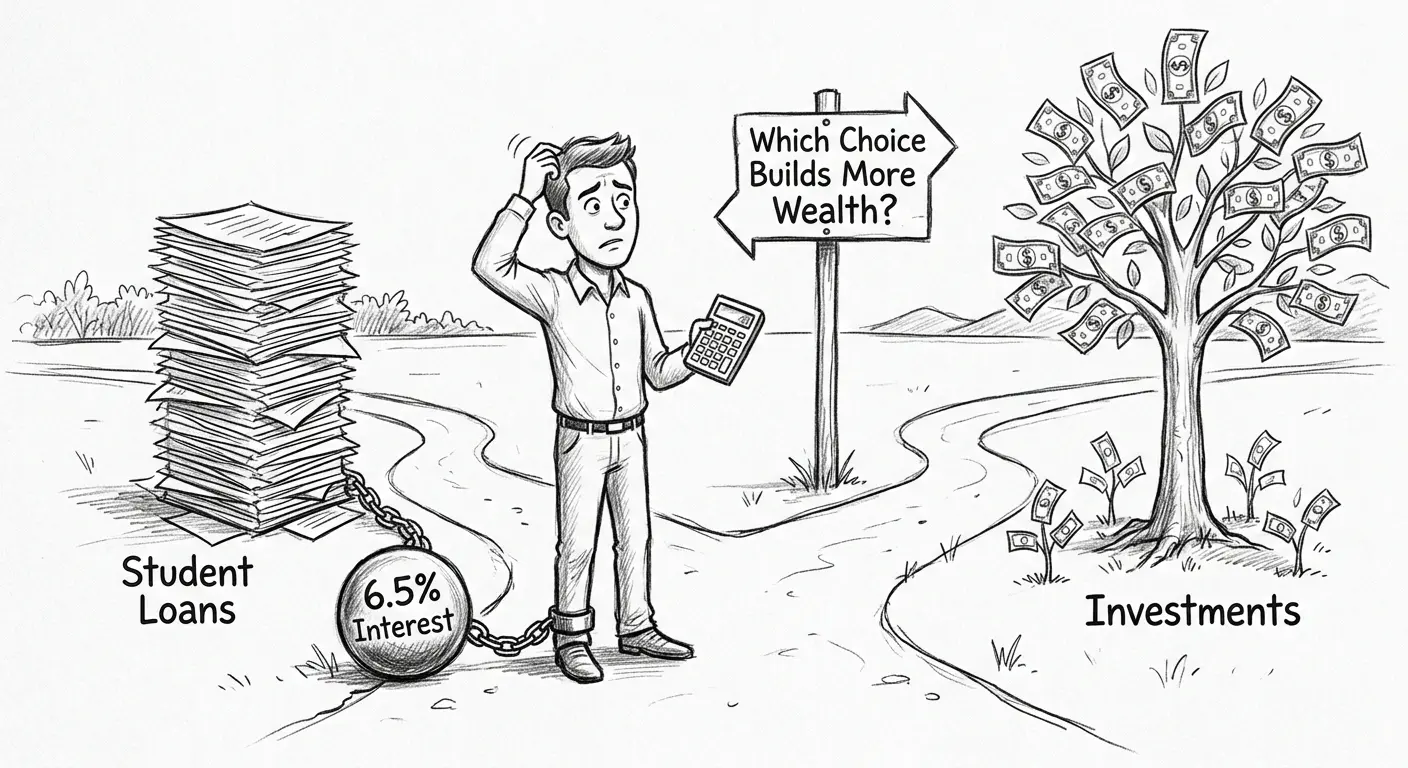
This is the core question, and the honest answer is: it depends on one number more than anything else — the gap between your loan’s interest rate and your investment’s expected return.
Your student loan interest is a guaranteed cost. If your rate is 6.5%, you pay that rate every single year, on whatever principal remains, regardless of what the stock market does. There is no scenario in which that interest rate moves in your favor. It compounds against you continuously.
Your investment return is not guaranteed. It might outperform the loan rate by a wide margin over a decade. It might underperform. It might lose value in the near term even if it recovers later. The range of outcomes is wide, and none of them are certain.
So the real question is never “stocks vs. debt” in the abstract. It’s whether the expected return from staying invested — after accounting for taxes and risk — is meaningfully higher than the guaranteed return from eliminating the loan. When loan rates climb above 6%, that math increasingly favors paying off the debt.
The Interest Rate Threshold That Changes the Calculation
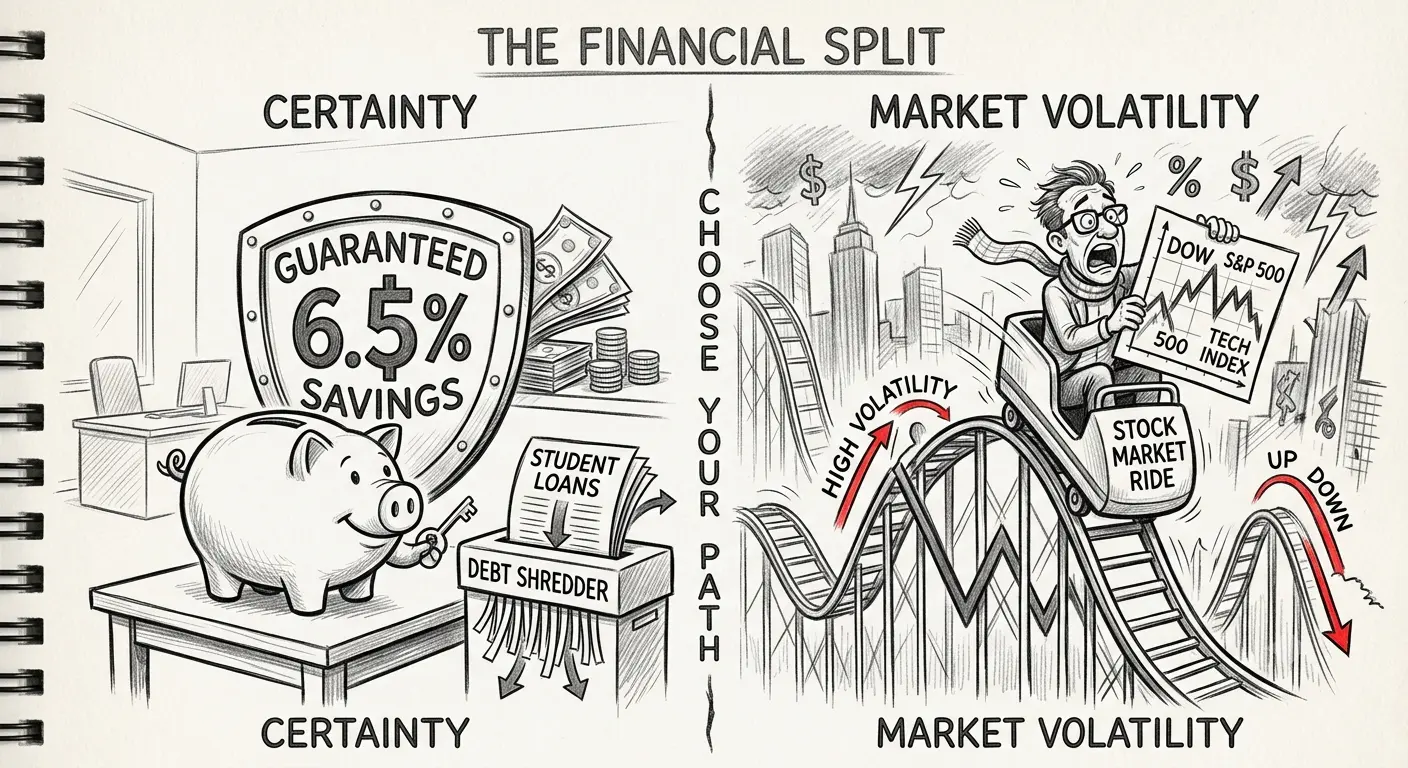
Most financial planners draw a rough line somewhere between 4% and 6%. Below that zone, the long-term expected return of a diversified stock portfolio has historically exceeded the loan rate by enough to justify staying invested. Above it, the guaranteed benefit of debt elimination starts to look more attractive than uncertain market gains.
Here’s a concrete way to think about it: paying off a 6.5% loan is functionally equivalent to earning a guaranteed 6.5% return on that money. No volatility, no sequencing risk, no bad years. The broad stock market has historically returned around 7–10% annually over long periods, but that average contains some very bad years alongside the good ones — and you can’t choose which years your money is in the market.
If your investment is expected to return 10% and your loan costs 6.5%, your net annual advantage from staying invested is roughly 3.5%. That’s before taxes on the investment gains. Is a 3.5% expected edge — with real uncertainty attached to it — worth more than a certain 6.5% savings? For most people in the 6–7% loan range, the answer leans toward paying off the debt.
For reference, the IRS publishes Applicable Federal Rates monthly, which give a sense of what the federal government considers “market rate” for loans. Student loan rates in the 6–7% range sit well above the long-term risk-free rate, which is part of why this decision becomes harder at those levels.
The Liquidity Risk Nobody Mentions
There’s a cost to paying off debt that doesn’t show up in an interest rate comparison, and it catches people off guard: money used to pay down a loan is permanently illiquid.
When you invest in stocks, you retain access to that capital. If a medical emergency hits, if you lose your job, or if a better investment opportunity appears, you can sell the stock and use the proceeds. The money is still working for you, but it’s also accessible.
When you pay down student loan principal, that money is gone. You cannot call your loan servicer and ask for it back. The debt decreases, which improves your balance sheet — but your liquid assets decrease by the same amount. If you face a financial emergency after eliminating the debt, your options narrow to credit cards, personal loans, or whatever remains in savings.
This is worth taking seriously before committing to a lump-sum payoff. A practical approach: maintain a cash emergency fund of three to six months of expenses before redirecting any investment proceeds toward debt. If liquidating your stock to pay off loans would leave you with minimal liquid savings, the risk profile of that decision changes significantly. The Consumer Financial Protection Bureau’s student loan resources cover hardship and deferment options, which are worth knowing about as a contingency before you close the door on liquidity.
Can You Use RSU Stock to Pay Off Student Loans?
Yes — but understand what you’re actually doing when you sell.
RSUs (restricted stock units) are grants from an employer that vest over time. When they vest, the market value of those shares is treated as ordinary income and taxed accordingly in the year of vesting. Your employer typically withholds shares or cash to cover that tax. After vesting, the remaining shares are yours to hold or sell, with a cost basis equal to the price on the vesting date.
If you sell those shares to pay off student loans, you owe capital gains tax on any appreciation since the vesting date. If you’ve held them more than a year, that gain is taxed at the long-term capital gains rate — 0%, 15%, or 20% depending on your income bracket. For most people earning in the $80,000–$100,000 range, that rate is 15% federally.
State taxes add to this. New York, California, and several other states tax capital gains as ordinary income, which can push the combined rate to 20–22% or higher depending on where you live.
The practical effect: selling $30,000 worth of appreciated stock doesn’t net you $30,000 toward your loan. After taxes, it might net $24,000–$26,000. That’s not a reason not to do it, but it changes how much you’ll actually pay off and how much tax planning makes sense before you act.
One strategy worth considering: spread the sale across two tax years. Selling some shares before December 31 and the remainder in January keeps your capital gains lower in any single year, which may help if you’re near a bracket threshold. The IRS explains cost basis rules and long-term capital gains rates in Topic No. 409.
When Paying Off Student Loans With Stock Usually Makes Sense
A few conditions point clearly in the direction of using investments to pay down or eliminate student loan debt:
Loan rate above 6%. This is the clearest signal. At 6% and above, the guaranteed benefit of debt elimination competes seriously with expected investment returns, especially once taxes on investment gains are factored in.
Heavy concentration in a single company’s stock. Holding most of your invested wealth in one company — particularly one you received through employment — carries risks that a diversified portfolio doesn’t. Company-specific events (earnings misses, management changes, regulatory problems, broader industry downturns) can cause a single stock to drop sharply even when the rest of the market is fine. That concentrated risk makes the guaranteed return from debt payoff more valuable by comparison.
No emergency fund outside the investment. If selling the stock leaves you without accessible savings, you’re trading investment risk for a different kind of risk. Pay off the debt only after you have a liquid cushion in place.
No employer 401(k) match being left uncaptured. An employer match is an immediate 50–100% return on that portion of your contribution. Always capture the full match before redirecting money toward debt payoff. Beyond the match, the loan-vs.-investing math takes over.
When Staying Invested Usually Makes More Sense
Loan rate below 4%. At these rates, the historical long-term return of a diversified equity portfolio has exceeded the cost of debt by enough to justify staying invested. People who held mortgages at 2.875% or car loans under 1% during the post-2008 period came out significantly ahead by investing the difference rather than paying off low-cost debt early.
Selling triggers an immediate and disproportionate tax bill. Capital gains taxes are due in the year of sale. If your stock has appreciated significantly, the tax cost of selling might offset several years of interest savings. This is particularly relevant for shares held a short time or for high earners in states with elevated capital gains rates.
Refinancing is available at a materially lower rate. Before selling anything, check what refinancing rates are available. Dropping from 6.8% to 4.1% on the same loan changes the debt-vs.-invest math considerably, and a refinance can achieve that without triggering a taxable event. Comparison tools like the one at NerdWallet’s student loan refinance page can show live rate ranges from multiple lenders.
You’re on track for loan forgiveness. Public Service Loan Forgiveness and income-driven repayment forgiveness programs can eliminate substantial loan balances after qualifying payment periods. If you’re enrolled in one of these programs and on track, paying extra principal — let alone liquidating investments — may cost you more than the forgiveness you’d otherwise receive.
The Hidden Cost: What Happens to the Freed Cash Flow
Paying off $30,000 in student loans frees up a monthly payment — often $400–$600 depending on the loan terms and how much extra you’ve been paying. What you do with that money matters nearly as much as the payoff decision itself.
If you redirect the freed payment into a diversified index fund immediately and consistently, you’re essentially continuing to build wealth at whatever rate that fund returns. Over the years you would have otherwise spent making loan payments, that monthly investment compounds into a real number.
If that cash flow gets absorbed into everyday spending instead, the long-term financial benefit of the payoff is much smaller. You’ve eliminated debt, which is good — but you haven’t replaced it with wealth accumulation.
Before committing to a lump-sum payoff strategy, be honest about your track record with discretionary cash. If you have a history of directing windfalls toward intentional goals, the payoff works as designed. If extra monthly cash tends to disappear into general spending, the calculus is less favorable than the interest rate math suggests.
Refinancing: Run This Option Before Selling Anything
Refinancing can solve the same problem without triggering a taxable event.
Private lenders have offered rates in the 4–5% range for qualified borrowers with good credit and stable income. Going from 6.8% to 4.1% on a $30,000 loan saves roughly $800 per year in interest — and keeps your investment intact.
The trade-off is real: refinancing federal student loans into a private loan permanently removes access to federal programs, including income-driven repayment, deferment options during hardship, and forgiveness programs. If none of those apply to your situation, it’s often worth getting quotes from multiple lenders and comparing the total interest cost over the remaining loan term.
A side-by-side loan payoff calculator — the Department of Education’s Loan Simulator covers federal loans — can show you what payoff looks like under different rate and payment scenarios before you decide anything.
A Decision Framework
Work through these questions before acting:
What is my loan interest rate? Above 6% is the range where the debt elimination argument gets serious. Above 7%, it’s hard to make a strong case for holding investments over the loans on pure math.
Is my investment concentrated in a single company? Concentrated positions carry risks that raise the value of the guaranteed return from debt payoff.
What would selling cost me after taxes? Calculate the approximate after-tax proceeds before assuming the trade makes sense. The after-tax number is what actually goes toward the loan.
Can I refinance instead? A lower rate may solve the problem without a taxable event. Get quotes before selling.
Do I have an emergency fund independent of this investment? Paying off debt eliminates liquidity. Maintain accessible savings before committing.
Will I actually redirect the freed monthly payment into investments? Be realistic. The long-term benefit of the payoff strategy depends on this.
The more of these questions point toward payoff, the stronger the case for selling some or all of the investment to eliminate the loans. Few financial decisions have a universal answer — but this framework gets you to the right one for your situation.
Diversification: A Separate Problem Worth Addressing

If a large share of your net worth is tied up in one company’s stock — particularly a former employer’s stock — that’s a risk management problem that exists regardless of the student loan question.
Holding a concentrated single-stock position means your financial outcome depends on one company continuing to perform well. Diversification across many companies and asset classes reduces the impact of any single company’s problems on your overall wealth. The general guidance from the SEC’s Office of Investor Education is consistent: concentration increases both upside and downside potential in ways that most investors underestimate.
If you sell company stock to pay off debt and invest the freed monthly cash flow into a broad-market index fund, you’ve accomplished two things: eliminated a guaranteed-cost liability and improved the structure of your remaining investments. That combination is worth more than either action alone.
Frequently Asked Questions
Can I use RSU stock to pay off student loans?
Yes. RSU shares are yours to sell after vesting, and the proceeds can be used for any purpose, including paying off student loans. The key consideration is taxes: you’ll owe capital gains tax on any appreciation since the vesting date. If you’ve held the shares more than a year, the long-term capital gains rate applies — typically 15% federally for most middle-income earners. Factor in your state’s tax treatment before calculating how much the sale will actually net toward your loan payoff.
What student loan interest rate makes it worth keeping investments instead of paying off debt?
Below roughly 4%, most financial guidance favors staying invested, because the long-term expected return of a diversified equity portfolio has historically exceeded that rate. Above 6%, the guaranteed benefit of debt elimination increasingly outweighs uncertain investment returns — especially once capital gains taxes on the sale are considered. Rates between 4% and 6% sit in a judgment zone where individual factors (concentration risk, tax situation, emergency fund status, refinancing availability) tip the decision.
Does paying off student loans affect mortgage qualification?
Yes, in a meaningful way. Mortgage lenders use your debt-to-income ratio (DTI) to determine how large a loan you qualify for. Student loan payments count toward your monthly debt obligations in that calculation. Eliminating $30,000 in student loan debt can increase your mortgage borrowing capacity by $50,000–$100,000 or more, depending on the loan structure and your income. If you’re planning to buy a home in the next few years, that impact is worth factoring into the timing of any payoff decision.
Is student loan interest tax deductible?
The federal student loan interest deduction allows you to deduct up to $2,500 in interest paid per year — but it phases out at higher income levels. For 2024, the phase-out begins at $75,000 for single filers and is fully eliminated at $90,000. If your income exceeds that threshold, the deduction may not reduce your tax burden at all, which weakens one of the common arguments for carrying the debt longer.
Disclosure: The information in this article is for educational purposes only and does not constitute financial, tax, or investment advice. Individual circumstances vary significantly. Consult a qualified financial advisor or tax professional before making decisions about liquidating investments or accelerating debt repayment. Potoolsblog.com does not receive compensation from any financial products, lenders, or services mentioned in this article. Outbound links to government and third-party sources are provided for reference only.